Sunday, 20 January 2013

A Season of Sequels


A season of sequels… written by Bridget Carrington featuring - 

Gregg Olsen: Betrayal
David Fuller: Alfie Jones and a Test of Character

Over a year ago I raved about Gregg Olsen’s Envy, the first book in his Empty Coffin series. Betrayal, the second, is now out, and it’s every bit as good as that first one. Set again in Port Gamble (the character of the town reflected in its aboriginal name which actually means ‘empty coffin!), and featuring the Ryan twins, Hayley and Taylor, whose extra-sensory abilities frequently guide them to the truth of the matter, as well as keeping them from disaster by alerting one to the other’s danger, it is partly based on a real-life case. Hard on the heels of the previous cyberbullying-related teen death in the town comes a new case, in which British exchange student Olivia Grant is killed at a Hallowe’en party. The twins are at the party, hosted by a fellow student while her parents are away, and are themselves among the suspects. Suspicion mainly falls on the teen hostess and her boyfriend, and when they disappear, many consider their guilt is proven. As ever in Olsen’s books, all is not as it seems however, and we have to negotiate several red herrings before we discover the true culprit.

Further layers are also unpeeled from the twins’ own family history, and we can guess that this will continue in the third book, Guilt, due out next year. The coach crash which they survived (unlike many of their classmates) at the age of five remains an ever-present mystery to be solved, but we discover that there are even greater mysteries still to be solved about their background and special psychic talents.
Olsen writes a sizzling story, and bases each book on a real crime, this time the Amanda Knox case, and reflects the moral and ethical issues raised by it, although the narrative of each book takes its own direction. Once again he appends an account of the real crime, and his Empty Coffin website at
http://www.emptycoffinseries.com/  provides all sorts of extras which are both entertaining and thought-provoking.
Highly recommended!


We met Alfie Jones in March 2012, in Alfie Jones and a Change of Fortune, and a very good book that was. Now Alfie’s involved in another football-filled story, in which his team meet their arch rivals in a tournament. There’s lots to learn about loyalty and friendship, and not judging people by the way they seem to be behaving. Alfie encounters another very shy boy, but like many shy people this young man has been bullied into behaving in an unfriendly way. However Alfie learns what his magical guardian witch Madam Zola means by not judging a book by its cover, and everything turns out well in the end.

Another excellent Alfie Jones book for boys (and girls) who are newly confident readers, and who are passionate about the beautiful game. They can even puzzle out the statistics at the back of the book which record the scores in each of the games played by the Kingsway Colts team at the tournament, and discover how the result is worked out.
More please…Up the Colts!

Sunday, 13 January 2013

Welcome to 2013...

It's been a few weeks since I visited the Blog and gave you any news, but well, it has been Christmas and the New Year and we are all allowed a little break.  Now that I am back I have lots of exciting news to share with you because I have spent most of this last week opening parcels of books - my desk at one point could not be seen for all the parcels and their lovely, exciting contents.

Everywhere you turn in recent days there have been reviews of the year and commentary on the best things from 2012 including books of course as well as insights into what 2013 could bring.

To begin then - the best books of 2012?  I think my favourite book was quite possibly The Girl Who Circumnavigated Fairyland in Ship of her own Making by Catheryne M Valente, and I am now reading the sequel so will report on that soon.  But really I don't thin it is fair to choose just one favourite and looking at the Bookseller Chart of bestselling titles many of these could rate among my favourites too along with all those which didn't reach the chart!

Looking into 2013 it is impossible to decide which books are going to prove a runaway success and which are going to tick along nicely pleasing a wide range of people.  However we have to start somewhere and where better than with the talented Charlie Fletcher whose Far Rockaway is now out as a paperback and an ebook featuring a cover image based on the work of an Edinburgh School of Art student - inspiring and beautiful and just one title among the lovely parcels I have opened so far this new year!  Read it for yourself to see what inspired the images and whether real girls can rescue themselves.

After this where can we go - well to the predicted trends for 2013 including more collaboration between readers and the publishing industry and in particular the new genre of 'new adult'.  There is plenty to look forward to, plenty to get your reading teeth into already and lots of reasons to follow this Blog, our Twitter feed @Armadillomag, 'Like' our Facebook page https://www.facebook.com/Armadillomag and regularly vsiit the website www.armadillomagazine.co.uk

I look forward to seeing you all in all these places!

Saturday, 15 December 2012

All About Love & Romantic Comedies


Liz Bankes, Armadillo reviewer and now author provides this week's guest Blog spot on Romance and romantic comedies...

What is it about the romantic comedy formula that makes people fall in love? Well, I will speak for myself – a rom com nut. For me there is nothing better than a story that combines love and laughter. Rom coms give you hope that among all the moments of humour and awkwardness that make up everyday life, you find love.

I think as well there is an excitement in embarking on a story and knowing that love awaits. You know it will be there, but you don’t know how, why or in what way it will happen. You can sit down at the beginning of a Shakespeare comedy, for example, knowing that come the end everyone will be coupled up and sharing a dance. But that doesn’t prepare you for the character pouring her heart out because the person she loves doesn’t notice her, the sparks flying between a bickering couple who haven’t realized yet that they are made for one another, or the moment when two people realize that they’ve fallen in love.

 So here are three of my favourite tales of love and laughing:

1. Pride & Prejudice by Jane Austen
The ultimate romantic comedy, in my opinion, and containing my absolute favourite literary couple. I find it hard to decide who I love more out of grumpy Darcy and witty Lizzie. Sparks fly and moments build between them, all contained within the rigid social structures of Austenland, which I think serves to make them all the more powerful and moving. I read this book probably about once a year – mainly for the line ‘dearest, loveliest Elizabeth’.
  
2. Twelfth Night by William Shakespeare
Viola is washed up alone after a shipwreck and separated from her twin brother. She dresses as a boy and goes to the court of Count Orsino, who she falls in love with. They become inseparable, but Viola has to listen to Orsino talking of his love for local noblewoman Olivia, while she can’t tell him who she really is or how she feels. This is my favourite Shakespeare play, all because of Viola and her speech ‘She sat like Patience on a monument, smiling at grief’, which goes right to the heart of unrequited love.

3. P.S. I Love You
Not quite the same formula as the others – the book sees Holly struggling to cope after Gerry, the love of her life, dies. He left her a series of letters, which she reads one by one, and Gerry guides her towards building a life without him in it.   This book combines laughter, strong emotion and the message that love never dies.

Thursday, 29 November 2012

Prehistoric or real? The dinoasurs...

In the last installment of short blogs from Simon Barrett thoughts turn to prehistory, dinoasurs and science...

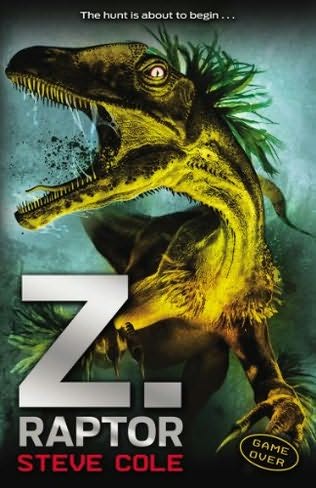
Dinosaurs are soooo prehistoric.  Z however stands for Zenith.  Geneflow and the mad scientist Samantha Josephs have accelerated grown dinosaurs from fossil material, engineered and augmented them with human capabilities and computer technology to make the perfect killing machines.  There is only one problem ... 13 year old Adam Adler.

The Z. series is a great trilogy, building up from one adventure to an international conspiracy.  It begins with Z.Rex and Adam’s first encounter with a living, breathing T-Rex with the capability to disarm a bomb.  Together they team up to rescue Adam’s Dad held captive by Geneflow.  In Z.Raptor Adam is marooned on a pacific island and part of a Geneflow game: hyper evolved dinosaurs with the minds of killers versus Adam and a handful of survivors.  While Adam is looking forward to a normal life, Geneflow have other plans.  Z.Apocalypse is a global emergency and once again Adam with the help of Zed needs to end Geneflow, before the world destroys itself in a Third World War.

Constant throughout the series is the relationship between Adam and his father Bill Adler.  Adam and Bill usually end up saving one another, motivated by their love for one another.  This takes on greater resonance in Z.Apocalypse, when Adam encounters the clone of his father.  Bill’s clone on one level should have no feelings towards Adam, but despite the technology and the science, something of the human spirit continues to survive and saves Adam.  Similarly with the dinosaurs, something of Adam’s spirit is passed on to them.  It is this spirit wanting freedom and valuing loyalty and friendship that fights against Geneflow’s desire to control and command.

Finally, another important question in the series, is who can you trust.  When you have the means to create the perfect killing machine that is immune to all conventional modern weaponry then there are too many vested interests.  Scientists, soldiers and politicians aid Adam and Bill in their quest to destroy Geneflow, but do they really want to destroy this technology or do they want to obtain this knowledge for their own purposes?

The Z. series has been a thrilling read as Adam is pursued around the world by mad scientists and over-sized reptiles.  In so doing, the author Steve Cole explores some important ideas about family, friendship and trust that will means this trilogy deserves to be reread and will continue to appeal to future readers.

Monday, 26 November 2012

Eon, Eona and Dragons

Short blog number 2 from Simon Barrett on Alison Goodman's titles Eon and Eona.

For me Eon by Alison Goodman was one of the best books of 2008.  It seemed to create a whole new cosmology drawing inspiration from Imperial China, in which the reader follows the struggles of a young girl, Eon, disguising her gender to become a Dragoneye, someone who can control the energy of a spiritual Dragon.  Eon more than achieves her aims and becomes the Mirror Dragoneye.  Joy turns to despair as a brutal rebellion usurps the Emperor’s throne and turns Eon’s world upside down.

I was therefore looking forward to Eona, the sequel to Eon, in which the Lord Dragoneye is recognised as a Lady Dragoneye, helping the rebels to fight and restore the rightful heir to the throne.  I suppose, like many sequels in which the heroes have fallen so far and the forces gathering against them so powerful, it is a dark and doubtful start to the story.  The sense of mistrust and betrayal heavily weighs on the main characters of Eona, the courtesan Dela and Eona’s bodyguard Ryko.  This lack of shared fate seems to dampen the story, whilst perhaps emphasising Eona’s solitude.  The author, Alison Goodman, also adds complexity to the cosmology of the Dragons to slowly reveal the true relationship between the Imperial Throne, the Dragoneyes and the spiritual powers of the Dragons.  Eona gathers pace, building up to the ultimate showdown between heaven and earth.

Alison Goodwin’s decision to write a duology is perhaps unusual in the current world of children’s literature.  The main story of the two books is straight-forward, however it is the complexity of the characters that enrich the story and is what I particularly enjoyed.  Two books however does not seem enough.  Without giving away the ending I had hoped for a happier ending.  This is however the world of fantasy and not fairy stories.

Friday, 23 November 2012

Thoughts on B R Collins

In the first in a series of 3 short blogs Armadillo Reviewer Simon Barrett shares his thoughts on B R Collins Maze Cheat (Bloomsbury).

The separation of reality and virtual reality is perhaps increasingly difficult, especially for young people today, whose interactions seamlessly move between their physical surroundings and a world on Facebook.  Gaming and virtual reality in particular has been a theme taken up by several children’s authors, including Alan Gibbons and by B.R. Collins in her recent book Maze Cheat.

Maze Cheat imagines a humanity retreating from a post-apocalyptic age of acid rain eating away the tarmac into the Maze, an interactive computer game.  Watched by everyone, Gamerunners fight, avoid traps and battle with monsters to earn kudos and money.  It is tempting to cheat, and Ario is the best Cheat there is.  Ario writes computer code to give Gamerunners infinite health and upgraded weapons, making them... invincible.  But the Maze is no ordinary computer game, something even the best Cheat can’t anticipate.

There is much about Maze Cheat that is probably conventional to young readers familiar with online games.  It is therefore the characters in the book that makes the story engaging with much of it taking place in a claustrophobic tank shop, where the cheats work, live and sleep.  Much of the tension is on what each of the characters know, but do not say to one another, and the hidden personal histories that suggests there is a shared fate or destiny.

I wonder whether books can fully capture a gamer’s experience or use some of the devices of Second life as a literary tool in a story.  Reading a book like Maze Cheat however reiterates the importance of characters in making a story a great story.

Saturday, 17 November 2012

Ribblestrop with Andy Mulligan

A short q & a between Andy Mulligan and Louise Ellis-Barrett talking about Ribblestrop, how it cam about, Andy's inspiration, favourite characters and more besides.  Read on to see inside the mind of an author ...

Thanks to Andy for taking the time to answer these questions for us.

I remember when the first Ribblestrop title, Ribblestrop, came out and I was both bemused and intrigued by the title which made me even more certain that I wanted to read it.  Was this the intention when you devised the name of the school?
My publisher chose the title, thinking the word was strong and intriguing. I loved the word because I used to spend time in the Ribble valley.  I don’t know where the “strop” came from.


Did you go to a school with a strange name, is that where the inspiration for the story came from?
No. My schools all had very sensible, nice names. The inspiration for ‘Ribb’ comes from many places…I will come back to that, I’m sure.

Did you go to a school with such a retrograde group of characters?
I think we’re surrounded by saints, demons and the inbetween all our lives. Yes, of course my childhood associates were strange – school shoves us through a very crude strainer, mincing us up with the best and worst of people. I loved passionately at school, and I hated with equal vim.

Could you explain a little more about how you created the characters, particularly the pupils?
The pupils are all based on children I’ve taught. Writing is theft: there are children in the schools I’ve taught in who have almost waved flags: “I belong in a book!” It’s a great way of getting revenge, sometimes, and paying homage too.

The books are both funny and a brilliant adventure, readers truly don't know what is going to happen from one line to the next let alone from one page to the next.  Is it difficult to write with such pace?
No. The writing comes easily, and sitting down to write Ribblestrop is always a joy – it’s like playing a very wild game, and the characters often surprise me. I am very, very fond of them, too, so animating them and giving them things to feel and say is a joyous process. What’s difficult is controlling the narrative, and hauling back into a manageable form.

Do you plan the story in advance and have it mapped in front of you?  In fact did you plan further ahead than just book 1 or has it grown itself?
The Ribblestrop books were always conceived as a trilogy, and I did have an ending in mind. In the event, the ending of ‘Ribblestrop, Forever!’ is radically different from the one I planned. The characters do not respond to strict planning. I do draw a map, but the characters tear it up very quickly.

Without revealing to readers how the story unfolds can you see more stories emerging from Ribblestrop or will you move on to new schools and new projects?
New projects, for sure. The ending of ‘Ribblestrop, Forever!’ is triumphant and I don’t want to try and better it.

Did you have crazy teachers, exciting field trips and mad police officers during your time at school?
No. Some of the stranger things that go on at Ribblestrop happened to friends of mine…I do steal ideas. For example, a close friend was lost with his classmates up a tunnel at his school in India – a young teacher mis-read the map and led the whole lot of them into the darkness. A train came, and they survived by pressing themselves to the rocky walls. If someone tells you that story you have a duty to steal it, and put it in a book, I think.

What is it that keeps you writing?
It’s very enjoyable. It’s fulfilling. It’s one of the only things I can do. I have friends who can play rugby and learn languages and surf…I get enormous pleasure from the rather solitary activity of writing. And I’m now in the very lucky position of people asking me to write.

Do you love to play with language?  I ask this question because the language in Ribblestrop, in fact in all your books is both powerful and engaging.  It is on a perfect level for children and yet as an adult I found it entirely engaging and at times challenging too.
I’m not sure I play with language, but I do enjoy it and I love trying to communicate. I don’t speak any other language: English is my mother-tongue, and I enjoy the attempt at precision. I admire Dennis Potter – a TV playwright who dominated the drama landscape all through the seventies up to his death in the nineties. His seemingly effortless command of words – the right words to express such fine nuances of meaning and such remarkable experiences – used to take my breath away. He didn’t show off. He found the right words, and enjoyed himself. That is definitely what I try to do. I can’t stand sloppy English, and I can’t stand attention seeking English either.

Reading these books I imagine an author who loves adventure, is slightly mad, a little bit outrageous and loves to laugh.  How would you describe yourself?
Solitary, nervous, ill-tempered and inconsistent.

If you were to go on a quest which of your characters would you take with you and why?
Anjoli. He is my favourite orphan. He’s based on a house-boy in India who used to serve me breakfast every morning when I taught in a school in the Himalayas. He’d be great company and would have every practical skill known to questing. When I got tired and angry he’d take the blame for everything, too.

Do you have a favourite character and were they based on anyone you have known, know now or are they purely a figment of your (possibly slightly crazy) imagination?
If Anjoli is my favourite orphan, then Miles is my favourite non-orphan. He’s based on a psychotic boy I taught a few years ago, and I have to say that I found him an absolute monster for a while. Then something cracked, and I saw what a fine, loyal, anxious soul he was, and he brought such life to the classroom. He was all fire!

Who were the authors that inspired you as a boy and who are the authors that inspire you now?  Do you still read children's books?
I don’t read children’s books, because I am always worried I’m going to like them more than my own attempts, and feel undermined. That may sound paranoid, but it’s the truth. I re-read stuff, hungrily, particularly when I’m in the middle of writing something. I constantly go back to Dickens, and I constantly re-read the travel books of Paul Theroux. Those writers have an intelligence and skill that inspire me. I feel dwarfed by them, but they make me want to try harder.

What advice could you give to our young readers inspired by your books?
Do you mean for writing, or for living? I have no advice at all for living, but for writing I’d pass on the one comment someone once made to me, at just the right time. He urged me to just sit down and write. That sounds a bit simple-minded, but what he meant was cut through the excuses for not getting down to it. ‘Oh, I’m tired… oh, I haven’t had an idea yet. Oh, I just need to check my email…Oh, there’s no hurry – I can do that chapter later.’ 
Close the door. Sit at your desk. Turn off your phone. Write.